How to Find SaaS Ideas People Will Actually Pay For in 2026 (With Real Data)
We analyzed over 8,000 Reddit threads and 300,000+ comments to find profitable SaaS ideas in 2026. Learn the 4 research methods, a 3 tier signal framework, and how to validate micro SaaS ideas before writing a single line of code.

You have probably seen those "50 Profitable SaaS Ideas for 2026" blog posts. They are everywhere. Hostinger published one. Elementor has their own version. So did Lovable, MicroConf, Microns.io, and dozens more. Every SaaS blog on the internet has published a list of "profitable SaaS ideas" at some point.
Here is the problem: most of those ideas have zero evidence behind them.
They read like someone asked ChatGPT to brainstorm 20 app ideas and then wrapped each one in a paragraph of generic advice. "Build an AI powered project management tool." Great. But does anyone actually need that? Would they pay for it? How much? What specifically frustrates them about current solutions?
None of those posts answer these questions. They give you ideas without evidence.
This post is different. Whether you are a non technical founder using vibe coding tools, a solopreneur building your first micro SaaS, or an indie hacker looking for your next project, the process is the same: find real problems before you write a single line of code. Over the past several months, I have analyzed over 8,000 Reddit threads containing more than 300,000 comments across subreddits like r/SaaS, r/Entrepreneur, r/microsaas, r/startups, r/indiehackers, and dozens of niche communities. This post walks through the exact process I use to find profitable SaaS ideas backed by real data, real quotes, and real examples.
Why Most Founders Fail Before They Even Launch
Whether you are a vibe coder shipping with Lovable or Cursor, a bootstrapped indie hacker, or a non technical founder hiring developers, the failure pattern is almost always the same. Here is how most first time SaaS founders come up with ideas:
- They brainstorm in a vacuum ("What if there was an app that...")
- They ask friends and family who say "yeah, that sounds cool"
- They spend 3 to 6 months building
- They launch to crickets
- They write a post on r/SaaS asking "how do I get my first customer?"
I know this cycle intimately because I lived it. I cold called 2 recruitment agencies to pitch my SaaS. They gave me a free masterclass on why my entire product was useless. I had built a CRM for care agencies in the UK based on the assumption that they were struggling to hire. Two phone calls revealed the entire market had flipped. People were now begging them for work. My "genius idea" was solving a problem that stopped existing months ago.
That post got 114,000+ views because every founder reading it recognized themselves in the story. As u/xtreampb commented: "In entrepreneurship, the goal is to kill bad ideas as fast as possible so you can move on and find the good ideas faster."
I could have learned this in one phone call before writing a single line of code. Instead, I built a whole product first. Classic.
So I decided I needed a system for market validation BEFORE building. That system eventually became ValidSaaS, a Reddit powered market validation engine for solopreneurs, indie hackers, and vibe coders who want to build products people actually need. And here is what I have learned from analyzing thousands of real conversations.
The Data Behind This Post
Before we go further, here is a summary of the data this post draws from. These are not hypothetical numbers. Each row represents actual harvests I have run and analyzed.
Every claim in this post is backed by this data. If you want to verify, the original analyses are published on Reddit: Part 1: r/SaaS Pain Points, Part 2: Lead Generation Deep Dive, and the full methodology breakdown.
The 4 Research Methods Most People Do Not Know About
Most people search Reddit manually. They open a subreddit, scroll through posts, maybe search a keyword. That gives you anecdotes. What you need is data.
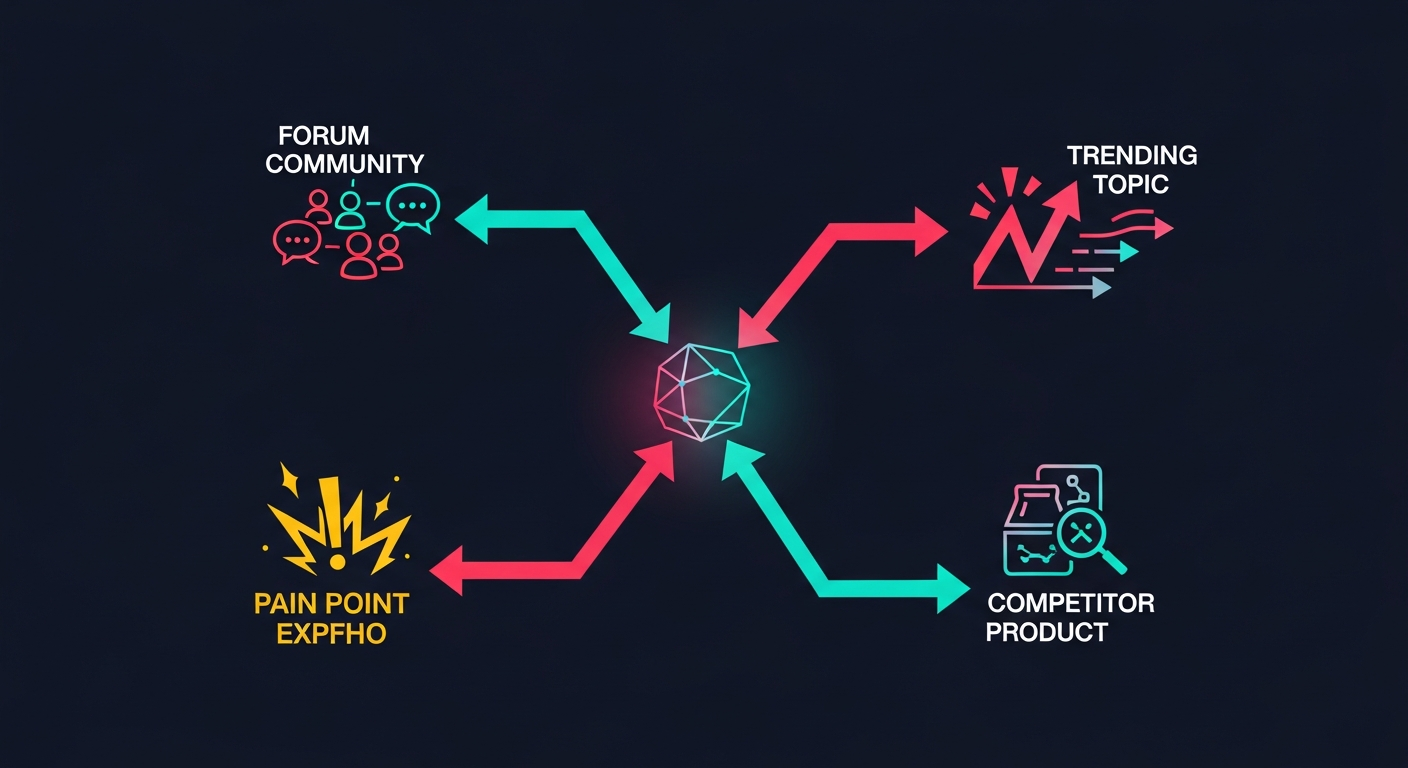
I developed 4 distinct methods for harvesting Reddit conversations, and each one surfaces a different kind of opportunity. I wrote about these in detail on r/microsaas, and here is how each one works.
Method 1: Search by Subreddit
Pick a specific community like r/freelance, r/accounting, or r/realtors and pull the top posts from the last 30 days. These carry the most comments and show what that community is actively struggling with.
When to use it: You already know your target audience. You want to understand their pain in their own words.
Example: I pulled 100 posts from r/SaaS and found that lead generation was the dominant topic, appearing in 43 out of 100 threads. That single harvest revealed the biggest unmet need in the largest SaaS founder community on Reddit.
Method 2: Search by Topic
Search something broad like "vibe coding" or "invoice automation" across ALL of Reddit, not just one subreddit. This crosses community boundaries and reveals whether a problem is niche or universal.
When to use it: You have a general area of interest but do not know which communities care about it most.
Example: Searching "invoice automation" might surface posts across r/freelance, r/accounting, r/smallbusiness, and r/Entrepreneur. If the same complaint shows up in 4 different communities, that is a much bigger market than any single subreddit would suggest.
Method 3: Search by Problem (in Buyer Language)
Already have a hypothesis? Search for that exact problem, but phrase it the way a buyer would describe it. Not "workflow optimization tool" but "I spend 3 hours every day on..."
When to use it: You want to validate frequency. How many people have this exact problem?
Example: I searched "chatgpt chat disappeared" and found hundreds of people describing this exact problem with zero existing solutions. That is a zero competition opportunity sitting in plain sight.
Method 4: Search by Competitor Name
This is the one nobody talks about and it is probably the most powerful. Search a specific tool name like "Lovable" or "Notion" or "Ahrefs" on Reddit, sorted by relevance. Hundreds of posts from real users discussing that tool will surface.
When to use it: You want to find opportunities within an existing product ecosystem. What are users complaining about? What do they wish the tool did differently?
Example: I scraped 100 posts mentioning Lovable and found 9 distinct opportunities backed by data. One was a tool to help migrate code from Lovable to self hosted infrastructure. I took 3 to 5 keywords from those comments ("migrating from lovable," "no code platform to self host"), searched those specifically, and found 130+ threads hyper focused on one problem. The data showed 20+ threads mentioning lock in, users spending $400/mo wanting to leave, and one person who spent 40 hours trying to manually export and "got nowhere."
The power comes from combining these methods. Start broad with Method 1 or 2 to discover patterns, then narrow down with Method 3 to validate frequency, then use Method 4 to map the competitive landscape. As u/Key-Boat-7519 commented: "What stands out is how you chained the search tactics into a funnel: broad sub to cross reddit topic to specific problem to brand ecosystem."
Try It Yourself
ValidSaaS scrapes real Reddit conversations and surfaces pain points, demand signals, and opportunities you can actually build on. Start with 2 free harvests.
How to Separate Signal From Noise
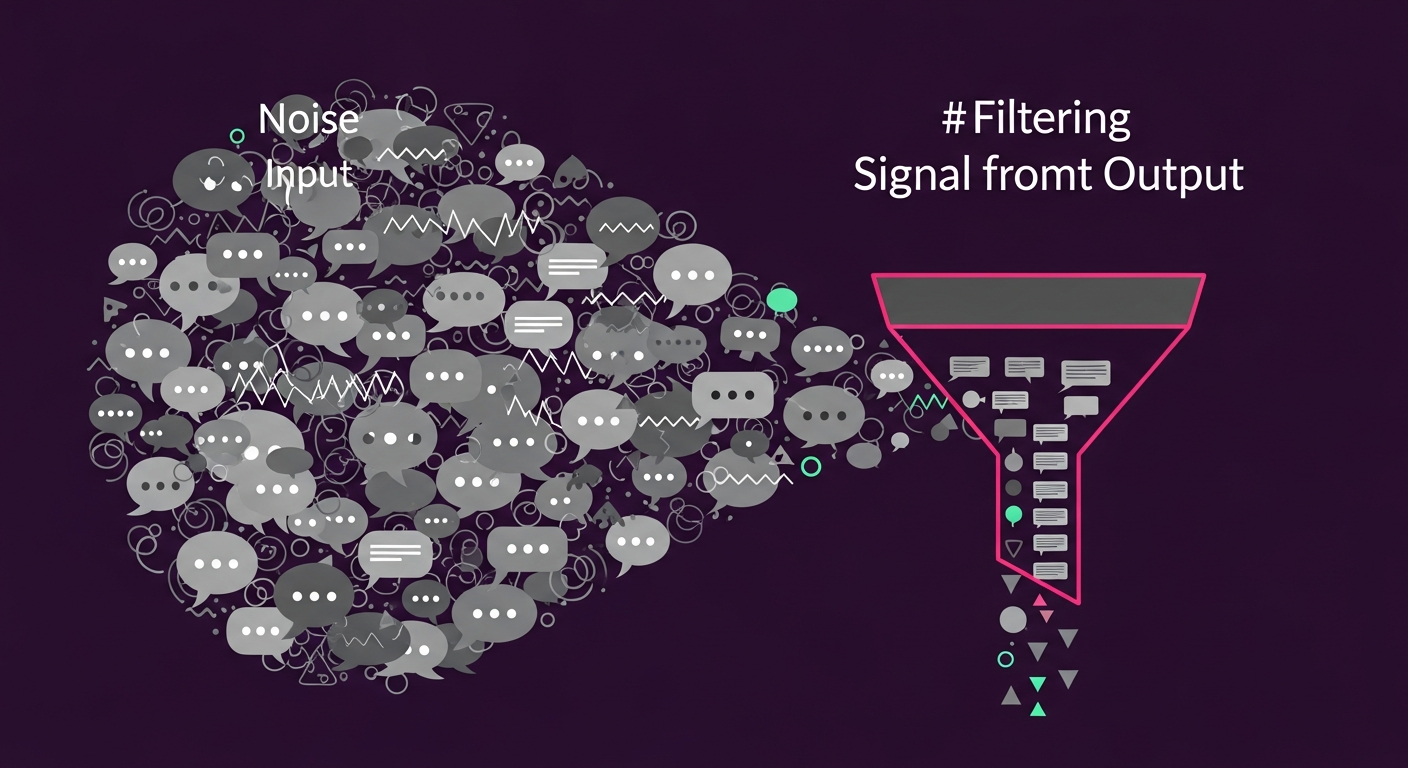
Finding conversations is the easy part. The hard part is knowing which ones represent real demand and which ones are just venting.
After analyzing over 300,000 comments, I developed a three tier framework for scoring signal quality.
Tier 1: Already Paying for Broken Solutions (Strongest Signal)
These are people who say things like:
"I'm paying $X for [tool] and it still can't do Y."
Or they have hired a VA, cobbled together a Zapier workflow, or built an internal spreadsheet. Willingness to pay is already proven. They are spending money. They are just not happy with what they are getting.
This is the strongest signal you can find because there is no ambiguity. The person has already voted with their wallet.
Tier 2: Quantified Pain (Strong Signal)
These comments attach numbers to their frustration. Hours lost, revenue missed, customers churned.
"1,847 messages sent, 11 replies received." — r/SaaS founder describing their cold outreach results
"100 outreach per day and I get 1 to 2 responses." — r/Entrepreneur founder
When someone quantifies their pain, they have thought about it enough to measure it. That level of awareness usually means they would pay for a solution.
Tier 3: Venting Without Stakes (Noise)
"Ugh, [tool] sucks."
No follow up. No numbers. No description of what they tried. Just frustration.
These comments get upvotes because people love to commiserate. But upvotes are not dollars. This tier has the highest volume and the lowest conversion to actual paying customers. Filtering it out is essential.
The Convergence Test
One subreddit can be an echo chamber. But when the same frustration shows up independently across multiple communities, the signal is reliable.
When I expanded my analysis to include r/Entrepreneur (100 more posts, 7,777 more comments), customer acquisition was the second biggest pain point there too (20+ threads), right behind idea validation. Two completely different communities. Same problem. That is convergence, and it dramatically increases your confidence that the opportunity is real.
A Real Example: How Lead Generation Emerged as the #1 Opportunity
Let me walk you through exactly how one SaaS opportunity surfaced from the data, step by step.
Step 1: Harvest the Conversations
I used Method 1 (by subreddit) to scrape 200 posts and 17,946 comments across r/SaaS and r/Entrepreneur. Not manually. Not by browsing threads one at a time. Using a systematic scraper that collects everything: post text, comment text, upvote counts, timestamps, and user context.
Step 2: Let the Patterns Emerge
Instead of looking for specific ideas, I let the data tell me what people care about. The analysis identified clusters of related complaints and requests. Lead generation was overwhelmingly dominant.
Real quotes from the data:
"I've poured so much into building this thing and I refuse to let it die because I can't figure out distribution." — u/Commercial-Zebra6899
"I am very new to all of this and do not know how to find leads, approach them, or schedule a demo." — u/Technical_Degree7710
"I was the entire growth engine and when I stopped, everything stopped." — r/SaaS commenter
"distribution skills are rarely taught to builders" — u/Famous-Call6538
Each of these is a real person describing a real problem they are actively trying to solve. Not a hypothetical user persona. A real person, posting from a real account, in a real community.
Step 3: Map the Competitive Landscape (Using Method 4)
Once lead generation surfaced as the dominant pain, I used Method 4 (by competitor name) to analyze every existing tool in the space.
Eight tools. All doing roughly the same thing: monitor Reddit for keywords, surface "leads," charge a subscription.
Step 4: Find the Gaps Nobody Has Filled
Despite 8+ tools in the space, multiple critical problems remain unsolved:
Gap 1: Discovery vs. Knowing What to Say. Every tool helps you find conversations. Zero tools help you craft a response that does not get you banned or ignored. As u/CikleHD put it: "Reddit keeps removing my posts" and "Cold DMing feels spammy."
Gap 2: No Prioritization. You get a list of 200 "leads" but no way to know which ones are Tier 1 (already paying for broken solutions) vs. Tier 3 (just venting). As u/Soft_Variety_8693 noted: "They don't have a lead problem, they have a prioritization problem."
Gap 3: No Pipeline After Discovery. You find the lead. You reply. Then what? No CRM. No follow up. No ROI tracking. You are copying usernames into a spreadsheet.
Gap 4: Quantity Over Quality. u/cursedboy328 described the reality: "250+ replies per week means you're sitting in that inbox for 2 to 3 hours every single day. And here's the part nobody warns you about: by reply #50, your brain is mush."
That is 15 to 20 hours per week of manual work, even with tools. At $50/hour, that is $3,000 to $4,000/month in labor cost.
Step 5: Score the Opportunity
This is what validated demand looks like. Not "I think people might want this." Instead: "Here are 8,000+ threads, 300,000+ comments, 8 existing competitors, 4 unsolved gaps, and quantified pain in dollars and hours."
How to Tell When an Idea is Bad
Every "how to find SaaS ideas" post out there is optimistic. "Here are 20 great ideas!" Nobody talks about red flags. I learned this lesson the hard way when two phone calls revealed my "genius idea" was solving a problem that no longer existed.
Here are the kill criteria I use now:
This is not just my opinion. When I shared my cold calling failure story on r/SaaS, a commenter with 8 years of cold outreach experience confirmed the same pattern. u/Potential_Product_61 wrote:
"The '2 phone calls would've saved me weeks' thing is the whole lesson right there. I spent 8 years doing cold outreach before building anything and the pattern is always the same. Founders treat validation calls like a chore instead of the actual product development."
That comment received 28 upvotes, the highest in the entire thread. It resonated because it captures a truth that experienced builders learn the hard way: validation is not a step you do before building. Validation IS the building. The research, the calls, the data collection, the pattern matching. That is the actual product development work. The coding comes after.
The Step by Step Market Validation Process
Here is how to replicate this entire process yourself:
Step 1: Pick a Domain You Understand
Do not start with "what SaaS should I build?" Start with an industry or workflow you know. If you have worked in ecommerce, start there. If you have freelanced, start there. Domain knowledge is your unfair advantage because you will recognize real pain vs. manufactured pain. This is especially important for non technical founders and vibe coders who need to move fast. The less time you waste on bad ideas, the faster you reach product market fit.
Step 2: Run All 4 Research Methods
Use the 4 methods described above systematically. Start with Method 1 (by subreddit) or Method 2 (by topic) for broad discovery. Use Method 3 (by problem) to validate frequency. Use Method 4 (by competitor) to map the competitive landscape.
Step 3: Score Every Signal
For each pain point that surfaces, run it through the three tier framework:
Step 4: Talk to Real Users (After You Have Data)
Note the order. Data first, then conversations. Most advice says "do customer interviews" as step one. The problem is you do not know what to ask yet.
When you go into interviews armed with data ("I found that 43 out of 100 r/SaaS threads are about lead generation. Is that consistent with your experience?"), you get much better answers than "So, tell me about your problems."
u/New_Grape7181 described this approach in action: tracking trigger events, reaching out with specific context, and seeing reply rates jump from 3% to 20%. The difference was knowing what to say because they understood the landscape first.
What Most "SaaS Ideas" Lists Get Wrong
I analyzed 16 of the top ranking blog posts for "how to find SaaS ideas" including articles from Hostinger, Elementor, Lovable, MicroConf, Microns.io, TekRevol, BigIdeasDB, and others. Here is what I found:
The biggest gap in every competitor's content: nobody shows their work. They give you the answer without showing how they got there. That makes it impossible to replicate. The framework in this post is designed to be something you can run yourself, today, on any idea.
Common Mistakes That Kill SaaS Ideas Early
Mistake 1: Building Before Validating. The Reddit data is clear on this. Nearly half of r/SaaS conversations are founders struggling to sell something they already built. As u/theADHDfounder noted: "The fact that you actually picked up the phone puts you ahead of like 90% of builders who just assume they know what people want." Validate first.
Mistake 2: Trusting Surveys Over Behavior. What people say they want and what they actually pay for are different things. Reddit comments are closer to real behavior because people are describing problems they are actively experiencing, not answering hypothetical questions. 200 posts from strangers who have no reason to be polite are harder to argue with than 5 enthusiastic calls.
Mistake 3: Ignoring Competitors. If nobody is building in your space, that is usually a bad sign, not a good one. You want to see 2 to 5 paid competitors because it proves the market exists. Then use Method 4 to find their gaps.
Mistake 4: Targeting Too Broad. "A project management tool for everyone" is a graveyard. "A project management tool for construction subcontractors" is a business. This is the micro SaaS advantage that solopreneurs and indie hackers have over venture backed startups. Narrow audience plus deep understanding equals sustainable growth and recurring revenue without needing millions in funding.
Mistake 5: Optimizing for Upvotes Instead of Dollars. A post with 500 upvotes about how [tool] sucks does not mean 500 people will pay for your alternative. It means 500 people enjoyed reading a complaint. Those are very different things.
Key Takeaways
Finding SaaS ideas is not the hard part. Reddit, Indie Hackers, G2 reviews, and Twitter are overflowing with complaints and feature requests. The hard part is separating signal from noise.
The process that works:
- Pick a domain you understand deeply
- Use all 4 research methods (subreddit, topic, problem, competitor) for complete coverage
- Score signals using the three tier framework (paying for broken solutions > quantified pain > venting)
- Map competitors and find their unsolved gaps
- Validate convergence across multiple communities
- Then talk to users armed with data driven questions
This is not a "50 ideas" listicle because listicles without evidence do not work. This is a repeatable framework you can use to find your own ideas backed by real data from real people.
My Reddit post about cold calling recruitment agencies and discovering my idea was worthless got 114,000+ views. It resonated because every founder, every indie hacker, every vibe coder has been there. The data is sitting in Reddit right now, in every subreddit, in every niche. You just need a systematic way to extract it.
And here is the thing about distribution that most SaaS founders miss: the same research you do to validate your idea also gives you your go to market strategy. When you know which subreddits your audience lives in, what language they use to describe their pain, and what solutions they have already tried, you already know exactly where and how to reach them. Validation and distribution are not separate steps. They are the same research.
If you do not want to run this research yourself, we also offer a Done For You validation service where we do the harvesting, analysis, and strategic recommendations for you.
Try It Yourself
ValidSaaS scrapes real Reddit conversations and surfaces pain points, demand signals, and opportunities you can actually build on. Start with 2 free harvests.
Frequently Asked Questions
How many Reddit posts do I need to analyze for reliable patterns?
At minimum, 50 posts with their full comment threads will give you directional data. For high confidence validation, aim for 100+ posts across at least 2 subreddits. The analyses in this post draw from over 8,000 threads and 300,000+ comments across multiple communities.
What if no competitors exist for my idea?
That is usually a red flag, not an opportunity. No competitors typically means no proven willingness to pay. The exception is when the technology to solve the problem is genuinely new (for example, LLMs enabling something previously impossible). In that case, look for people solving the problem manually as evidence of demand.
How do I find the right subreddits for my niche?
Start with the obvious ones (r/SaaS, r/startups, r/Entrepreneur) then look for niche subreddits specific to your domain. For ecommerce, check r/ecommerce and r/shopify. For dev tools, check r/webdev and r/programming. The niche subreddits often have higher signal to noise ratio because the audience is more focused. You can also use Method 2 (by topic) to discover which communities are talking about your area.
Is Reddit data representative of the broader market?
Reddit skews toward technical, English speaking users. For B2B SaaS targeting developers, founders, or tech workers, it is very representative. For consumer products targeting non technical audiences, supplement with G2 reviews, Twitter complaints, and Facebook groups. The convergence test also helps here: if the same pain shows up on Reddit AND G2 AND Twitter, you can be confident it is a real market.
How long does this validation process take?
It depends on your approach. If you do it manually (using Reddit's .json endpoints to pull data and scoring each thread in a spreadsheet), expect 20 to 40 hours per 100 posts depending on comment depth. This is honest, thorough work and many successful founders validate this way.
The shortcut most people try is pasting everything into ChatGPT or Gemini. This produces surface level summaries but misses the specific, scored patterns you need. Large volumes of Reddit data (500K+ tokens) cause significant quality degradation in general purpose LLMs.
Using a purpose built tool like ValidSaaS compresses the same analysis to under 30 minutes because it processes each post individually rather than summarizing everything in one pass. The competitive gap analysis (Method 4) still requires 2 to 4 hours of manual research regardless of approach. And if you want the entire thing handled for you, we offer a Done For You service that includes research, analysis, and a strategic interpretation you can act on immediately.
What is the difference between a vitamin and a painkiller in SaaS?
A vitamin is something that is nice to have. "It would be cool if my CRM could also do X." A painkiller solves an urgent, ongoing problem that costs real time or money. "I spend 15 hours a week manually doing X and it is killing my business." Always build painkillers. The signal framework in this post is designed to help you tell the difference using real data instead of guessing.
This analysis is based on real data from over 8,000 Reddit threads containing 300,000+ comments scraped from r/SaaS, r/Entrepreneur, r/microsaas, r/startups, and dozens of niche communities. All quotes are from real users and are attributed where possible. You can read the original analyses on Reddit: The Cold Calling Story, r/SaaS Pain Points Analysis, Lead Generation Deep Dive, and The 4 Research Methods.
Keep Reading
How to Find SaaS Ideas on Reddit: 7 Subreddits Where Users Share Real Pain Points
Stop guessing what to build. These 7 subreddits contain thousands of unfiltered complaints, feature requests, and willingness to pay signals from real users. Learn exactly how to mine them for validated SaaS ideas.
Pain Point Analysis for SaaS: The 3 Questions That Reveal High Intent Opportunities
Learn the 3 question framework for analyzing SaaS pain points that separates real demand from noise. Includes a scoring rubric, real Reddit examples, and step by step instructions for indie hackers, vibe coders, and bootstrapped founders.
The Reddit Research Method: How to Validate Any SaaS Idea in 48 Hours
A step by step framework for using Reddit data to validate SaaS ideas in 48 hours or less. Includes the exact process used to analyze 8,000+ threads, score pain signals, map competitors, and determine if an idea is worth building.