Pain Point Analysis for SaaS: The 3 Questions That Reveal High Intent Opportunities
Learn the 3 question framework for analyzing SaaS pain points that separates real demand from noise. Includes a scoring rubric, real Reddit examples, and step by step instructions for indie hackers, vibe coders, and bootstrapped founders.

Every SaaS founder has heard the advice: "Find a pain point and solve it." It sounds simple. It is not.
The problem is not finding pain points. Reddit alone has millions of people complaining about thousands of problems every single day. The problem is that most pain points will never convert into paying customers. People complain about things they would never pay to fix. People vent about minor annoyances that sound serious but carry zero urgency. People upvote gripes about tools they will keep using anyway.
After analyzing over 8,000 Reddit threads and 300,000+ comments across r/SaaS, r/Entrepreneur, r/microsaas, and dozens of niche communities, I developed a three question framework that filters noise from signal. It separates the pain points that lead to sustainable recurring revenue from the ones that lead to $0 MRR and a graveyard of failed MVPs.
Whether you are a vibe coder shipping with Cursor or Lovable, a non technical founder evaluating ideas, or an indie hacker looking for your next micro SaaS, this framework works the same way.
Why "Find a Pain Point" Is Incomplete Advice
The internet is full of advice telling founders to "start with a problem." Books like The Mom Test and Lean Startup hammer this point. And they are right. But they skip the crucial middle step: not all problems are equal, and most are not worth solving.
Here is what typically happens when a solopreneur follows the "find a pain point" advice without a scoring system:
- They browse r/SaaS or r/Entrepreneur and find someone complaining about invoicing
- They check Product Hunt and see 40 invoicing tools
- They think "I can build a better one"
- They spend 3 months building
- They launch and discover that nobody switches invoicing tools on a whim
The pain was real. The market existed. But the specific complaint they latched onto lacked the characteristics that predict willingness to pay. There was no urgency, no budget already allocated, and no measurable cost to doing nothing.
If you have read our guide on how to find SaaS ideas people will pay for, you already know the four research methods for sourcing conversations. This post is about what comes next: how to evaluate and score the pain points those conversations reveal.
The 3 Questions Framework
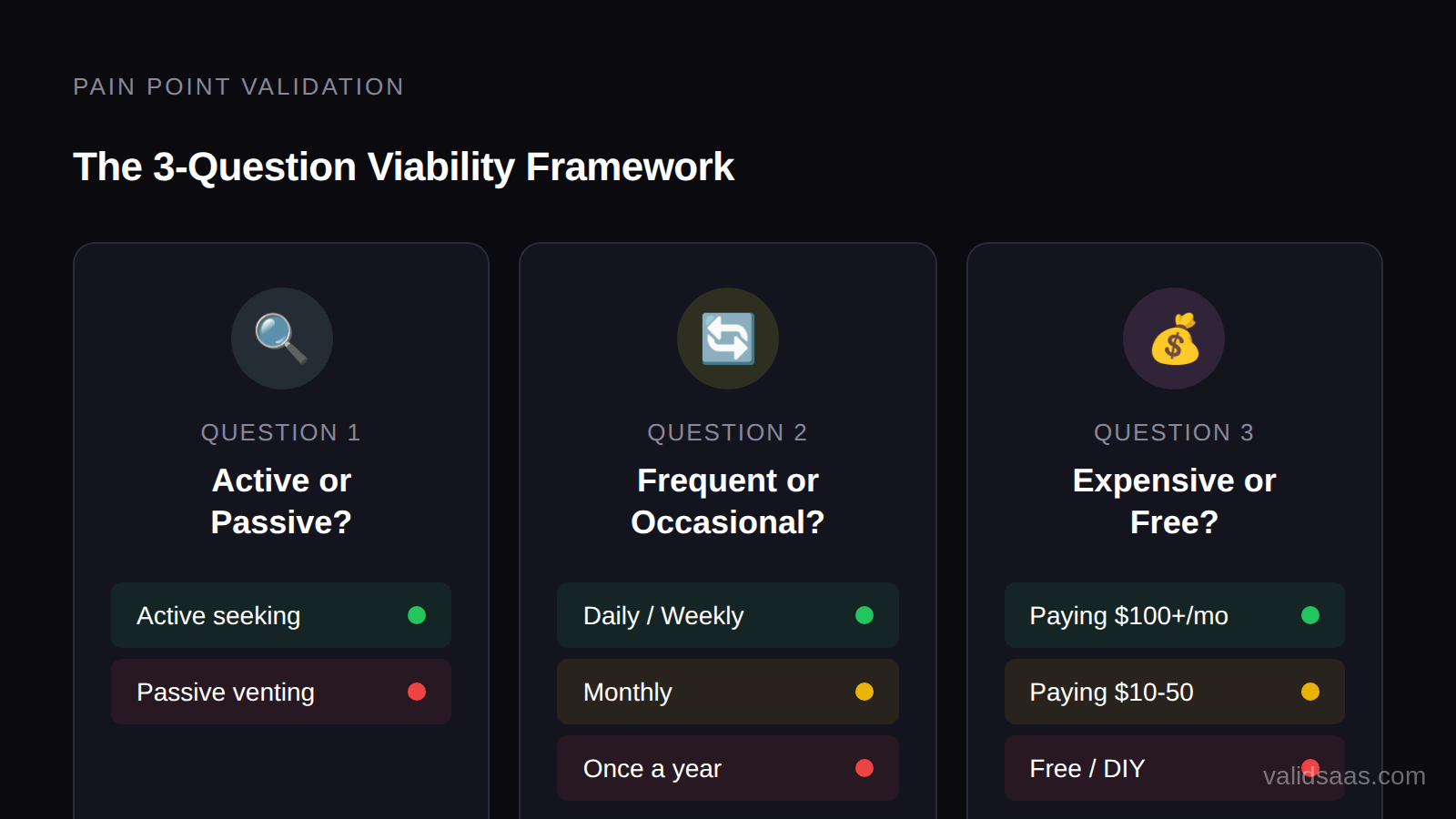
Every pain point you discover should be run through these three questions. Each question maps to a specific dimension of opportunity quality, and together they produce a reliable signal score.
Question 1: Is the pain ACTIVE or PASSIVE?
Active pain means the person is currently trying to solve the problem. They are searching for tools, posting "looking for recommendations," trying workarounds, or building something themselves. Passive pain means they noticed the problem, complained about it, and moved on.
How to spot active pain in Reddit comments:
Active pain is dramatically more valuable because it reveals existing behavior you can improve. When someone says "I built a spreadsheet to track client follow ups," they have already allocated time and mental energy to this problem. You are not convincing them the problem exists. You are offering a better version of what they are already doing.
I see this pattern constantly when running pain point analyses on ValidSaaS. In one harvest of 100 posts from r/SaaS, 43 threads were about lead generation. But within those 43 threads, the split was roughly 60% active pain (people describing workarounds, mentioning tools they had tried, quantifying hours spent) and 40% passive pain (general frustration about getting customers). The active 60% represented the real market. The passive 40% represented noise.
Question 2: Is the pain FREQUENT or OCCASIONAL?
A pain point that occurs daily is worth far more than one that happens once a quarter. Frequency determines whether someone will adopt a tool and keep paying for it month after month. This is the foundation of recurring revenue for any bootstrapped SaaS.
The frequency scoring rubric:
The SaaS businesses with the highest retention rates solve daily or multi daily problems. Think about the tools you personally use every day: your email client, your code editor, your project management tool. You never cancel those subscriptions because the pain returns the moment you stop using them.
Contrast that with a tool you use once a quarter. No matter how good it is, you will constantly question whether the monthly fee is worth it. For a solopreneur or indie hacker building a micro SaaS, targeting daily frequency problems is one of the strongest predictors of product market fit.
Question 3: Is the pain EXPENSIVE or FREE?
This is the question most founders skip, and it is the one that matters most. Every pain point has a current cost, even if the person experiencing it does not realize it. Your job is to calculate that cost.
Three ways pain has a price tag:
-
Time cost. "I spend 15 hours a week on manual outreach." At $50/hour, that is $3,000/month. A tool that cuts it to 3 hours saves $2,400/month.
-
Tool cost. "I am paying $200/mo for Salesforce but only using 10% of it." They are already budgeted for a solution. You just need to offer a better fit at a lower price.
-
Opportunity cost. "I lose 2 to 3 deals per month because I cannot follow up fast enough." If each deal is worth $500, that is $1,000 to $1,500/month in lost revenue.
When you can quantify the cost of doing nothing, your pricing conversation becomes trivial. A tool that costs $49/month but saves $2,400/month in time is not an expense. It is a 48x return.
Here is how to calculate the pain cost from Reddit data:
If the monthly cost of the pain is less than $30, you will struggle to sell a SaaS subscription against it. If it is $200+, you have significant pricing headroom. The sweet spot for bootstrapped micro SaaS is solving a $200 to $2,000/month problem and charging $29 to $97/month for the solution.
Try It Yourself
ValidSaaS scrapes real Reddit conversations and surfaces pain points, demand signals, and opportunities you can actually build on. Start with 2 free harvests.
Putting It All Together: The Pain Point Scoring Matrix
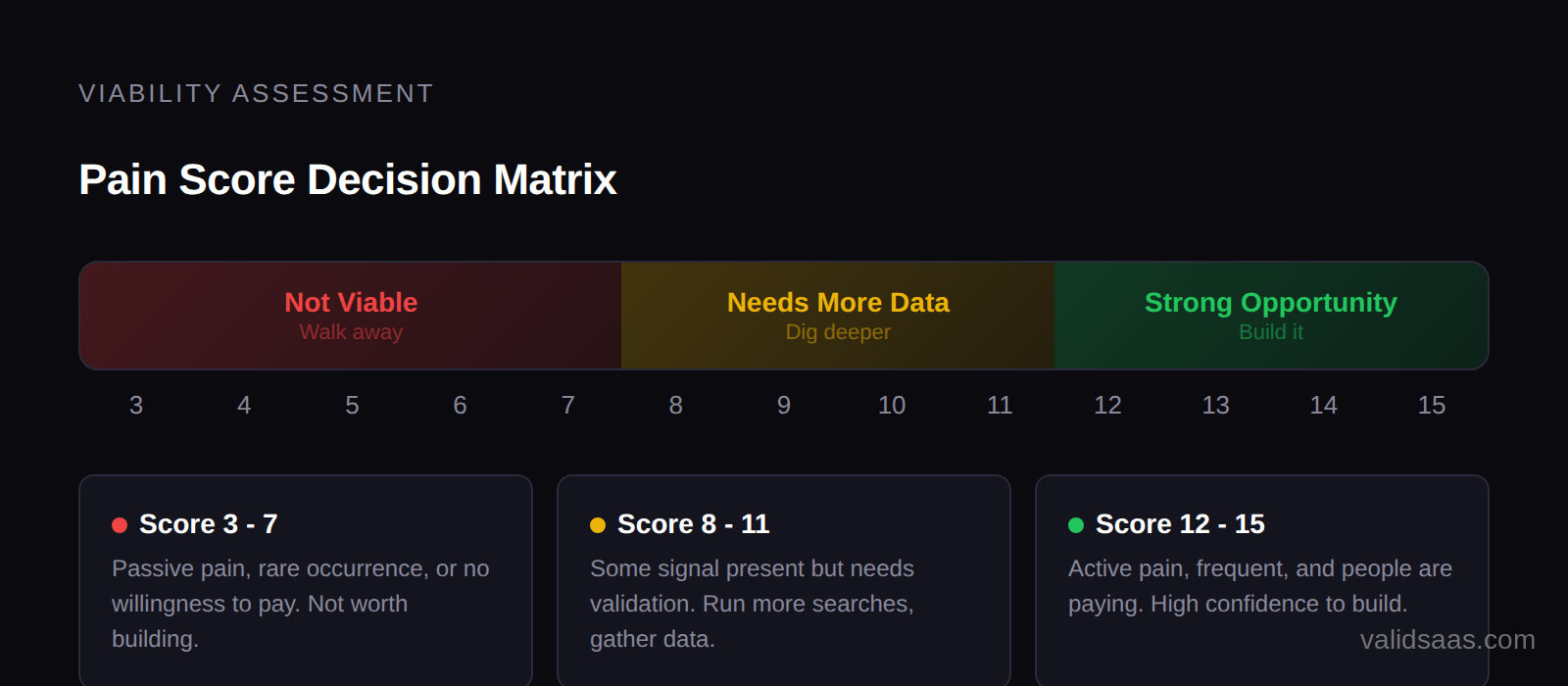
Now combine all three questions into a single scoring system. For each pain point you discover, rate it on each dimension:
Scoring interpretation:
Real Example: Scoring a Pain Point From r/freelance
Let me walk through a live example. While running a harvest across freelancer subreddits, this pattern emerged repeatedly:
"I spend at least 2 hours every Monday chasing overdue invoices. I send reminders, check my bank, cross reference against my spreadsheet. It is the worst part of being a freelancer."
Question 1: Active or Passive? Active. This person has a spreadsheet (workaround), a routine (every Monday), and a specific process they follow. Score: 4/5.
Question 2: Frequent or Occasional? Weekly, with some daily elements (checking bank for payments). Score: 3/5.
Question 3: Expensive or Free? 2 hours per week at $75/hour (typical freelancer rate) = $600/month in time cost. Plus potential lost income from delayed payments. Score: 4/5.
Total: 11/15. Promising, needs competitive analysis. And in fact, tools like FreshBooks, Wave, and Bonsai already serve this market, confirming willingness to pay. The next step would be using the competitor analysis framework to find gaps in what these tools offer.
The Most Common Mistake: Treating Upvotes as Demand
This is worth its own section because it kills more SaaS ideas than any other error.
A Reddit post titled "I hate how Slack notifications work" gets 2,000 upvotes. A founder sees this and thinks: "2,000 people want a better notification system. I should build one."
No. 2,000 people enjoyed reading a relatable complaint. That is entertainment, not demand.
Here is the difference:
When you run a pain point analysis, count the comments that demonstrate active behavior, not the upvote count on the post. Ten comments describing detailed workarounds are worth more than 10,000 upvotes on a generic complaint.
How to Source Pain Points at Scale
Doing this manually is possible but slow. Reading through 100 Reddit threads and their comments takes 20 to 40 hours. Here is how to do it properly, and why the obvious shortcut does not work.
The Manual Method (Free, Thorough, Time Intensive):
- Pick 2 to 3 subreddits where your target audience hangs out
- Use Reddit's JSON trick: add
.jsonto any subreddit URL (e.g.,reddit.com/r/freelance/top/.json?t=month&limit=100) to get raw structured data - For each post, grab the comments too:
reddit.com/r/freelance/comments/[post_id]/.json - Open each post and read the top 20 to 30 comments
- Copy every comment that describes active pain into a spreadsheet with columns: Quote, Subreddit, Active/Passive, Frequency, Cost Estimate, Signal Tier
- Score each one using the 3 question framework above
- Look for clusters: multiple people describing the same pain
This works. It is the method I started with, and many successful founders have validated ideas this way. The tradeoff is time.
Why "just paste it into ChatGPT" does not work:
When you have 100 posts and 5,000+ comments, the natural instinct is to dump everything into Gemini or ChatGPT and ask it to identify pain patterns. Here is why that produces unreliable results:
- 100 posts with full comment threads = 500K to 1M tokens of text
- Even models with large context windows experience quality degradation at that volume
- The AI tends to summarize the most prominent posts and miss the patterns hidden in less popular threads
- Crucially, it cannot reliably score signals using the Active/Passive, Frequency, and Cost framework because it loses track of individual data points across hundreds of thousands of words
You end up with generic categories like "marketing challenges" instead of the specific, scored pain points you need to make a build decision.
The purpose built approach:
ValidSaaS was designed around this exact problem. Instead of stuffing everything into one prompt, it processes each post and its comments individually, scores signals with domain context, and then synthesizes patterns across the full dataset. The difference is structured analysis versus brute force summarization. 100+ posts with full comments in minutes, with each pain point scored on the framework described in this post.
If you prefer not to run the research at all, we also offer a Done For You validation service where we handle the harvesting, scoring, and strategic interpretation for you.
Either way, the key is volume. You need enough data points to see patterns. A single Reddit comment is an anecdote. Fifty comments describing the same pain across three different subreddits is a signal. That is why cross subreddit validation matters so much.
Pain Points by SaaS Category: Where the Highest Signal Lives
Based on the data I have collected, certain SaaS categories consistently produce higher scoring pain points than others:
Notice how billing, lead generation, and data migration consistently score highest. They involve money (making it or losing it), they happen frequently, and people are already spending on partial solutions. These are the categories where bootstrapped founders and indie hackers find the strongest product market fit.
What to Do After You Score a Pain Point
A high scoring pain point is not a green light to build. It is a green light to investigate further. Here is the sequence:
-
Run competitive analysis. Use the SaaS competitor analysis framework to map every existing solution. If there are zero competitors, be cautious. If there are 2 to 10, you are in the sweet spot.
-
Validate cross subreddit. Does this pain appear in at least 3 communities? Read our guide on cross subreddit validation for the methodology.
-
Size the market. Use the TAM SAM SOM framework to estimate whether this opportunity can support a viable business at your target price point.
-
Scope the MVP. Once validated, use the MoSCoW method to cut your feature list to the absolute minimum needed to solve the core pain. Do not build a platform. Build a painkiller.
-
Pre sell before building. The ultimate validation is someone paying before the product exists. Our guide on pre selling SaaS before MVP walks through exactly how to do this.
Frequently Asked Questions
How many pain points should I analyze before picking one?
Analyze at least 10 to 15 distinct pain points before committing. Score each one using the 3 question framework. You want to compare relative scores, not just evaluate a single idea in isolation. The strongest opportunities become obvious when you see them alongside weaker ones.
Can I use this framework outside of Reddit?
Absolutely. The three questions (active vs passive, frequent vs occasional, expensive vs free) apply to any source of customer feedback: G2 reviews, support tickets, Twitter complaints, Indie Hacker forums, Slack communities, or customer interviews. Reddit is simply the largest and most accessible source of unfiltered, unsolicited feedback.
What if the pain point scores high but has 20+ competitors?
A crowded market with strong pain signals is actually a positive indicator. It confirms willingness to pay. Your job is to find the gap in existing solutions, which usually falls into one of three categories: a specific underserved segment (vertical SaaS), a simpler and cheaper alternative for small teams, or a better integration with tools the audience already uses. Check our vertical SaaS opportunities guide for ideas on how to niche down within crowded markets.
How do I distinguish between "nice to have" and "must have" pain?
Must have pain costs real money or time and the person experiencing it has already tried to solve it. Nice to have pain generates complaints but no action. The clearest signal is whether someone has built a workaround. Spreadsheet tracking, manual processes, hired VAs, duct taped Zapier automations. If they have invested effort into solving it badly, they will pay for a tool that solves it well.
Should I focus on B2B or B2C pain points?
For bootstrapped founders and solopreneurs building micro SaaS, B2B pain points almost always produce better outcomes. B2B buyers have budgets, can expense software, experience pain during work hours (high frequency), and measure ROI. B2C buyers are more price sensitive and harder to retain. Read our full comparison in B2B vs B2C SaaS: which to build for a deeper analysis.
This framework is based on analysis of 8,000+ Reddit threads and 300,000+ comments. If you want to run pain point analysis on your own niche, ValidSaaS automates the harvesting and scoring process so you can validate in minutes instead of weeks.
Keep Reading
How to Find SaaS Ideas on Reddit: 7 Subreddits Where Users Share Real Pain Points
Stop guessing what to build. These 7 subreddits contain thousands of unfiltered complaints, feature requests, and willingness to pay signals from real users. Learn exactly how to mine them for validated SaaS ideas.
The Reddit Research Method: How to Validate Any SaaS Idea in 48 Hours
A step by step framework for using Reddit data to validate SaaS ideas in 48 hours or less. Includes the exact process used to analyze 8,000+ threads, score pain signals, map competitors, and determine if an idea is worth building.
SaaS Idea Kill Criteria: 7 Data Backed Signs You Should Pivot or Quit
Not every SaaS idea deserves to be built. Learn the 7 kill criteria that separate doomed projects from real opportunities, based on analysis of 8,000+ Reddit threads and dozens of failed SaaS launches.