SaaS Idea Kill Criteria: 7 Data Backed Signs You Should Pivot or Quit
Not every SaaS idea deserves to be built. Learn the 7 kill criteria that separate doomed projects from real opportunities, based on analysis of 8,000+ Reddit threads and dozens of failed SaaS launches.

The hardest skill in SaaS is not building. It is quitting.
Every founder I have talked to, every Reddit thread I have analyzed, every failure story I have read, they all share the same pattern: the founder knew something was wrong months before they admitted it. They saw the signals. They chose to ignore them. And they kept building.
I know because I did exactly the same thing. I built a CRM for UK care agencies, convinced myself the market was real, and then two phone calls revealed the entire market had flipped. The problem I was solving had literally stopped existing. That post got 114,000+ views because every founder recognized themselves in the story.
Since then, I have spent months analyzing over 8,000 Reddit threads and 300,000+ comments through ValidSaaS to identify the patterns that separate viable ideas from dead ends. This post covers the 7 kill criteria I use now to evaluate every SaaS idea before investing more than 48 hours into it.
Why Kill Criteria Matter More Than Idea Generation
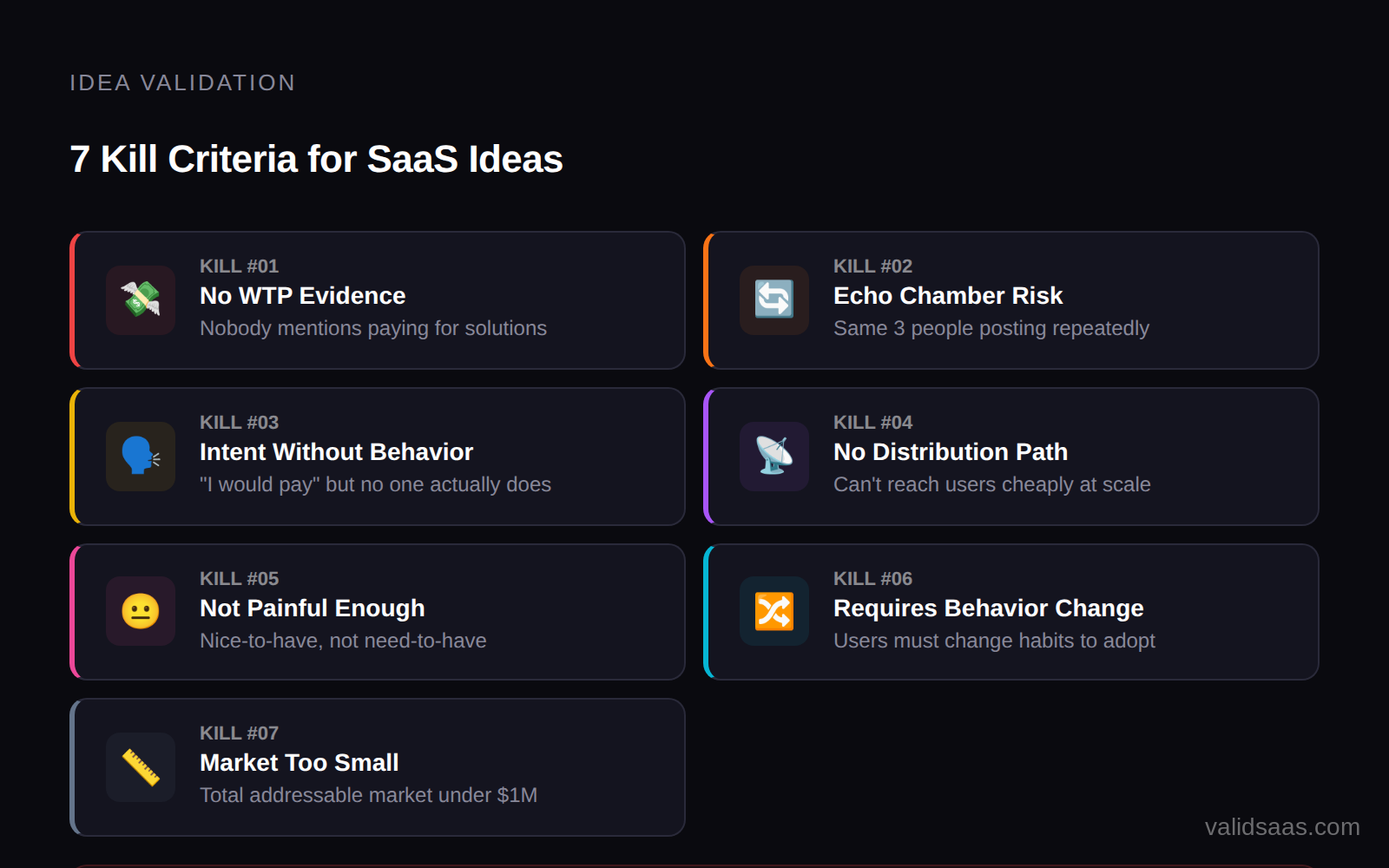
The internet is obsessed with finding ideas. "How to find SaaS ideas." "50 micro SaaS ideas for 2026." "AI powered idea generation." Finding ideas is not the hard part. There are dozens of validated micro SaaS ideas sitting in Reddit threads right now. The hard part is knowing which ideas to kill.
The math makes this clear:
The third path is the only one that makes sense for bootstrapped indie hackers, solopreneurs, and vibe coders who cannot afford to spend 6 months on the wrong idea. Kill fast, learn fast, find the real opportunity faster.
As one commenter on my cold calling post put it: "In entrepreneurship, the goal is to kill bad ideas as fast as possible so you can move on and find the good ideas faster." That comment got the most upvotes in the entire thread because it is the single most important lesson in SaaS.
Kill Criterion 1: No Willingness to Pay Evidence
The test: Can you find at least 3 instances of people spending money on partial solutions to this problem?
What it looks like when it fails: You find hundreds of Reddit threads complaining about a problem, but nobody mentions paying for any tool to solve it. No competitor tools exist. Nobody describes workarounds that cost money or time.
Why it kills the idea: Complaints without spending are vitamins. People enjoy complaining about vitamins, but they do not pay to fix them. Painkillers have spending attached. When someone says "I pay $99/mo for X and it still cannot do Y," that is a painkiller market.
Real example: I found dozens of threads in r/programming about "ugly terminal output." Lots of upvotes. Lots of agreement. Zero people spending money on prettier terminals. That is a vitamin. Contrast with lead generation, where I found 8 paid tools ranging from $7/mo to $79/mo. That is a painkiller market.
Exception: When genuinely new technology enables something previously impossible (like LLMs enabling natural language interfaces), you may not find existing spending. In that case, look for people spending significant time on manual workarounds as a proxy for willingness to pay.
Kill Criterion 2: Single Community Echo Chamber
The test: Does this pain point appear independently in at least 2 unrelated subreddits?
What it looks like when it fails: You find 30 threads about a problem, but they are all in one subreddit. Some reference each other. A few are from the same users. The "pattern" is actually one viral post that spawned copycats.
Why it kills the idea: One subreddit is a sample size of one community, not one market. Communities develop groupthink. A pain point that exists only in r/SaaS might be unique to the SaaS founder bubble and not representative of how actual buyers think.
The convergence test: Search for the same pain in your target audience subreddit AND an adjacent community. When I validated the lead generation opportunity, I found it was the dominant pain in r/SaaS (43 out of 100 threads) AND the second biggest pain in r/Entrepreneur (20+ threads). Two independent communities, same problem. That is convergence.
For the full cross community validation process, see The Reddit Research Method.
Kill Criterion 3: Stated Intent Without Behavior
The test: Are people describing what they DO (behavior) or what they WOULD DO (intent)?
What it looks like when it fails: You post "Would you pay $29/mo for a tool that does X?" and get 50 comments saying "Absolutely!" or "Shut up and take my money!" Then you build it and nobody signs up.
Why it kills the idea: Stated intent is almost worthless as validation data. People are generous with hypothetical dollars. They say yes to sound supportive, because it costs them nothing. The research is clear on this: what people say they will do and what they actually do are different things.
What to look for instead:
- Past tense behavior: "I tried X and it did not work" (they actually used something)
- Current spending: "I am paying $X for Y" (they are actively spending money)
- Time investment: "I spent 3 hours yesterday doing this manually" (they are investing real time)
- Workarounds: "I built a spreadsheet/Zapier workflow/hired a VA" (they cared enough to create a solution)
The three tier signal framework is built specifically to filter behavior from intent. Use it ruthlessly.
Kill Criterion 4: No Natural Distribution Channel
The test: Can you reach your first 100 customers without paid advertising?
What it looks like when it fails: Your target audience does not congregate anywhere specific online. They do not have a subreddit. They do not have a newsletter. They do not search for solutions on Google. To find them, you would need to run Facebook ads, cold email, or attend trade shows.
Why it kills the idea (for bootstrapped builders): Distribution is the number one unsolved problem for SaaS founders. When I analyzed r/SaaS, the most common frustration was not "I cannot build the product." It was "I cannot find customers." As one founder wrote: "I have poured so much into building this thing and I refuse to let it die because I cannot figure out distribution."
If your target audience is not concentrated in discoverable communities, your customer acquisition cost will eat your margins. For a bootstrapped indie hacker or solopreneur, that is a death sentence.
What good distribution looks like:
- Your audience has a subreddit with 50,000+ active members
- Your audience searches for solutions on Google (validate with Ahrefs or Ubersuggest)
- Your audience reads specific newsletters or publications
- Your audience attends specific online events or forums
- You can write content that ranks for terms your buyers search
The best SaaS ideas come with built in distribution. The same subreddits where you find the pain are the same channels where you will find customers. That is the core insight of How to Find SaaS Ideas on Reddit: validation research and go to market research are the same thing.
Try It Yourself
ValidSaaS scrapes real Reddit conversations and surfaces pain points, demand signals, and opportunities you can actually build on. Start with 2 free harvests.
Kill Criterion 5: The Problem Is Not Painful Enough
The test: Do users describe the problem with urgency language? Do they quantify the cost of not solving it?
What it looks like when it fails: Users say things like "It would be nice if..." or "I wish there was a better way to..." without any sense of urgency. No quantified time cost. No revenue impact. No emotional weight.
Why it kills the idea: "Nice to have" products do not generate recurring revenue. People sign up for free trials, poke around, and never convert. Or they convert and churn within 60 days because the problem was never painful enough to justify the monthly expense.
The Painkiller Test:
If your Reddit research produces mostly vitamin language, the pain is not deep enough to support a SaaS business. This does not mean the idea is bad. It means the audience you are looking at is not desperate enough to pay. Try a different segment. A feature that is a vitamin for enterprise might be a painkiller for freelancers, or vice versa.
Kill Criterion 6: Requires Behavior Change
The test: Does your solution fit into an existing workflow, or does it require users to adopt an entirely new process?
What it looks like when it fails: Your product is genuinely better, but using it requires people to change how they work. Switch from email to your messaging platform. Abandon their spreadsheet for your dashboard. Learn a new interface. Change a habit.
Why it kills the idea: Humans resist behavior change even when the alternative is objectively better. The most successful micro SaaS products do not replace workflows. They enhance existing ones. A plugin for a tool people already use is easier to sell than a standalone app that replaces that tool.
Examples from the data:
The micro SaaS sweet spot is: take a tool people already use, find the part they hate, and fix that specific part. This is why the best micro SaaS ideas are integrations and add ons rather than standalone platforms.
Kill Criterion 7: Market Too Small for Recurring Revenue
The test: Can you reach $10,000 MRR with a realistic number of customers at your target price?
What it looks like when it fails: Your SaaS solves a real problem, but the total addressable market is too small. Maybe the pain exists in a subreddit with 2,000 members, and even with aggressive conversion, you max out at 50 customers at $29/mo. That is $1,450/mo. Not enough to sustain a business.
Why it kills the idea: Micro SaaS still needs a viable market. "Micro" refers to the team (1 to 3 people), not the revenue ceiling. You need enough potential customers to sustain growth, handle churn, and reach a level of recurring revenue that justifies ongoing development.
The quick math:
"Reachable prospects" means people you can actually get in front of, not total market size. For a deeper dive into market sizing, see TAM SAM SOM for SaaS.
Higher price points require fewer customers, which is one reason B2B typically beats B2C for solo founders. But even B2B needs enough market to sustain growth after early adopters are exhausted.
The Kill Decision Framework
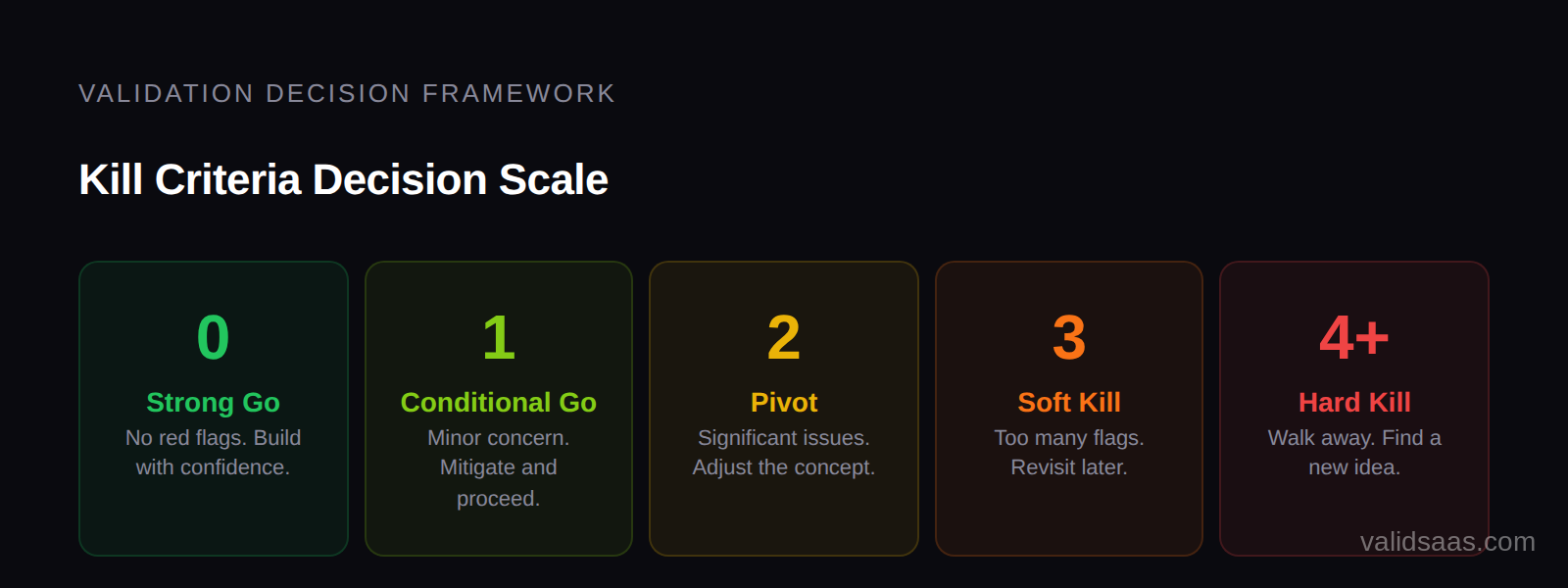
When you have scored your idea against all 7 criteria, use this decision matrix:
The emotional difficulty of killing an idea scales with how long you have worked on it. That is why the Reddit Research Method limits initial validation to 48 hours. It is much easier to kill an idea you spent a weekend on than one you spent 6 months building.
What To Do After You Kill an Idea
Killing an idea does not mean starting from scratch. The research you did has value even if the specific idea failed.
Salvage the data. Your Reddit research surfaced pain points, competitor intelligence, and audience insights. Most of that transfers to adjacent ideas. The subreddits and communities you mapped are still valuable.
Look for the pivot within the data. Often the idea that failed was adjacent to an idea that would work. Maybe the problem is real but you were targeting the wrong audience. Maybe the market is there but the price point needs to change. Review your research with fresh eyes.
Document the kill signal. Write down exactly which criterion killed the idea and why. This builds pattern recognition. After killing 5 to 10 ideas, you will start recognizing kill signals instinctively, before you even start the formal evaluation.
Move fast. The point of having kill criteria is speed. Every hour you spend on a dead idea is an hour not spent on a live one. Give yourself 48 hours to grieve, then start the Reddit Research Method on the next opportunity.
The fastest way to cycle through ideas is to run the kill criteria evaluation on each one in parallel. You can do this manually by pulling Reddit JSON data (add .json to any Reddit URL) and scoring threads in a spreadsheet, which takes about 20 to 40 hours per idea. Or you can use ValidSaaS to compress the research to under 30 minutes per idea, which means you can evaluate 5 to 10 ideas in a single weekend. If you want expert eyes on your specific situation, our Done For You service includes kill criteria evaluation as part of a full validation report.
Frequently Asked Questions
What if my idea fails one criterion but passes the other six?
Look at which criterion it fails. Failing on "No Willingness to Pay Evidence" is much worse than failing on "Single Community." Some criteria are harder to overcome than others. If there is no evidence of willingness to pay, that is almost always a hard kill. If convergence is limited to one community but all other signals are strong, it might be worth investigating the adjacent communities more deeply.
Should I kill an idea if it has too many competitors?
No. Too many competitors means the market is validated. The question is not "are there competitors?" but "are there gaps?" If 8 tools exist and users still complain about the same 4 unsolved problems, those gaps are your opportunity. I found exactly this pattern in the lead generation space.
How many ideas should I evaluate before committing to one?
At least 5, ideally 10. The point of having a 48 hour evaluation process is that you can cycle through ideas quickly. If you evaluate 10 ideas and kill 9, the remaining one has survived serious scrutiny. That is worth more than picking your first idea and hoping it works.
Can I use kill criteria on an idea I have already started building?
Absolutely. In fact, that is one of the most important applications. If you are 3 months into building and starting to feel doubt, run the kill criteria. Be honest. If your idea fails 3 or more criteria, the sunk cost fallacy is the only thing keeping you going. It is cheaper to stop now than to stop 3 months from now.
What if the pain is real but seasonal?
Seasonal pain can still support a SaaS business if the pain is intense enough during the season. Tax preparation tools are seasonal. Wedding planning tools are seasonal. The key question is whether customers will maintain their subscription year round or cancel after the season ends. If they cancel seasonally, your churn math will be brutal.
Is there a difference between kill criteria for B2B and B2C?
The criteria are the same, but the thresholds differ. B2C can tolerate lower willingness to pay evidence because consumer impulse purchases are more common. But B2C also requires much larger addressable markets because price points are lower and churn is higher. For help deciding between B2B and B2C, read B2B vs B2C SaaS: Which Should You Build?.
These kill criteria were developed from analysis of 8,000+ Reddit threads, 300,000+ comments, and dozens of SaaS failure stories across r/SaaS, r/Entrepreneur, r/microsaas, and r/startups. For the positive side of validation, read How to Find SaaS Ideas People Will Actually Pay For.
Keep Reading
How to Find SaaS Ideas on Reddit: 7 Subreddits Where Users Share Real Pain Points
Stop guessing what to build. These 7 subreddits contain thousands of unfiltered complaints, feature requests, and willingness to pay signals from real users. Learn exactly how to mine them for validated SaaS ideas.
Pain Point Analysis for SaaS: The 3 Questions That Reveal High Intent Opportunities
Learn the 3 question framework for analyzing SaaS pain points that separates real demand from noise. Includes a scoring rubric, real Reddit examples, and step by step instructions for indie hackers, vibe coders, and bootstrapped founders.
The Reddit Research Method: How to Validate Any SaaS Idea in 48 Hours
A step by step framework for using Reddit data to validate SaaS ideas in 48 hours or less. Includes the exact process used to analyze 8,000+ threads, score pain signals, map competitors, and determine if an idea is worth building.